
The Last Claims Handler
What happens to claims handlers when AI agents take on more of the work? Artem Gonchakov explores the shift from processing claims to governing AI.


A disclosure before I start.
I run Simplifai - we build AI Agents for Insurance. So read everything that follows knowing I have a position. I am not a neutral observer, and I am not pretending to be one.
But I am not here to sell you software. I am here to tell you that the category of software you have bought for thirty years is about to stop mattering, and that the job at the center of your business is about to change more than it has changed since the adding machine. I would rather you understood that and disagreed with me than nodded along and missed it.
We build AI Agents for insurance. Distribution, Underwriting, Policy Administration, Claims,Customer Service - essentially, the whole value chain. But around 9 in 10 of our first conversations with a carrier start with claims. That is not an accident. Claims is the most expensive, most influential, most emotionally charged part of the business. It is where the promise is kept or broken. It is the natural place to start, so I will write about claims, but the logic extends everywhere else.
For 30 years the software industry digitized the filing cabinet and never once touched the job. AI Agents are the first software that does the job.
First, understand what the claim job actually is
Most people outside the industry think claims handling is administration. Forms in, payments out. They are wrong, and the people who run claims know they are wrong, but there is a reason for it and you will know in a minute.
A claim is a small investigation under time pressure.
A handler reads a loss description and decides what it really means. She checks it against a policy written in language designed by lawyers to be precise and inconvenient. She decides what is covered and what is not. She sets a reserve, which is a prediction about the future cost of something that has not finished happening yet. She spots the file that smells wrong, the third "rear-ended at a junction" from the same garage this month. She calls a customer who has just had a fire, or a death, or a car written off with their child in the back seat, and she manages that conversation like a professional. She negotiates with a contractor, a lawyer, another insurer. She knows when to pay fast and when to slow down.
That is interpretation. Prioritization. Negotiation. Judgment. Emotional labor. Pattern recognition built over years of seeing things go wrong in particular ways.
Now look at the day around that judgment. It is buried. The same handler spends 30 to 40 percent of her time on administration - many carries automating admin work, that is all they can think of due to neverending pressure and increasing complexityi. Chasing a missing police report. Emailing a customer for the third time about a photo. Retyping the same loss details into a claims system, a document system, a fraud tool, a payment platform, a communication portal. Navigating fifteen or twenty different pieces of software just to move one file one step. Queues that do not distinguish a court deadline from a routine windscreen. Overload as the normal operating condition. The most skilled judgment work in insurance is performed in the gaps between data entry.
The industry has known this for decades, and look at what it did about it. Transformation after transformation. Every 5 to 10 years someone decides the answer is a better core platform, and a migration begins: 2 or 3 years, tens of millions, enormous organizational pain, and at the end the handler has a newer screen to type into. The job evolved, but it never reached its peak, because the platform was never the problem. Then an entire industry grew up after the core vendors, point solutions trying to automate tasks or fragments of the process. Intake bots. Document extraction. Fraud scoring. Each one partially successful. Each one another login, another integration, another tile on the handler's screen. They lit the fire. They proved parts of this work could be done by a machine. None of them did the job.
Policy admin systems stored the policy. Claims systems stored the claim. Document management stored the documents. BI counted what had already happened. Every system was built to help a human do the work faster. None of them did the work. The handler still read the file. The handler still decided. The software was a filing cabinet with a search box, and forty years of upgrades produced a better cabinet.
This is the thing I need you to sit with, because the rest of the argument depends on it.
For 30 years the software industry digitized the filing cabinet and never once touched the job. AI Agents are the first software that does the job. Not assist it. Do it. Read the file, interpret the policy, set the reserve, draft the decision, talk to the customer, and hand a human the cases that genuinely need a human. That is a different kind of product. It is not a tool that helps a person work. It is software that does the thinking and the work. That distinction is the whole story.
The silent shock running through software
Here is what almost nobody in insurance is saying out loud, because it is a software story and insurance people do not think of themselves as software people. The entire software industry is in a quiet panic, and the panic is directly relevant to you.
In December 2024, on the BG2 podcast, Satya Nadella said the part out loud. Business applications "are essentially CRUD databases with a bunch of business logic," and in the agent era "that's probably where they'll all collapse." CRUD means create, read, update, delete. That is what your claims system is underneath. A database with a workflow stapled on top and a screen for a human to type into. When an AI Agent holds the business logic and can read and write across many databases at once, the application layer becomes redundant. The database survives. The screen does not.
The CEO of the world's largest software company said the dominant model of business software will collapse. Sit with that.
Now watch what the industry did in 2025 and 2026, because the behavior tells you more than the words. Klarna announced it had shut down Salesforce and Workday to run on its own AI, reported revenue per employee climbing from 575,000 dollars toward a million, then quietly walked parts of it back. Salesforce itself pivoted the entire company to Agentforce, with Marc Benioff selling "digital labor" and pricing by the conversation instead of the seat. Zendesk moved to charging per AI resolution, payment for completed work instead of payment for a logged-in human. ServiceNow, SAP, Workday, every major vendor raced to ship agents into their platforms. Think about what per-seat pricing means in a world of agents. A seat is a human at a screen. When the agent does the work, the seat disappears, and with it the revenue model that built the entire SaaS industry. That is the panic. It is not philosophical. It is on the income statement.
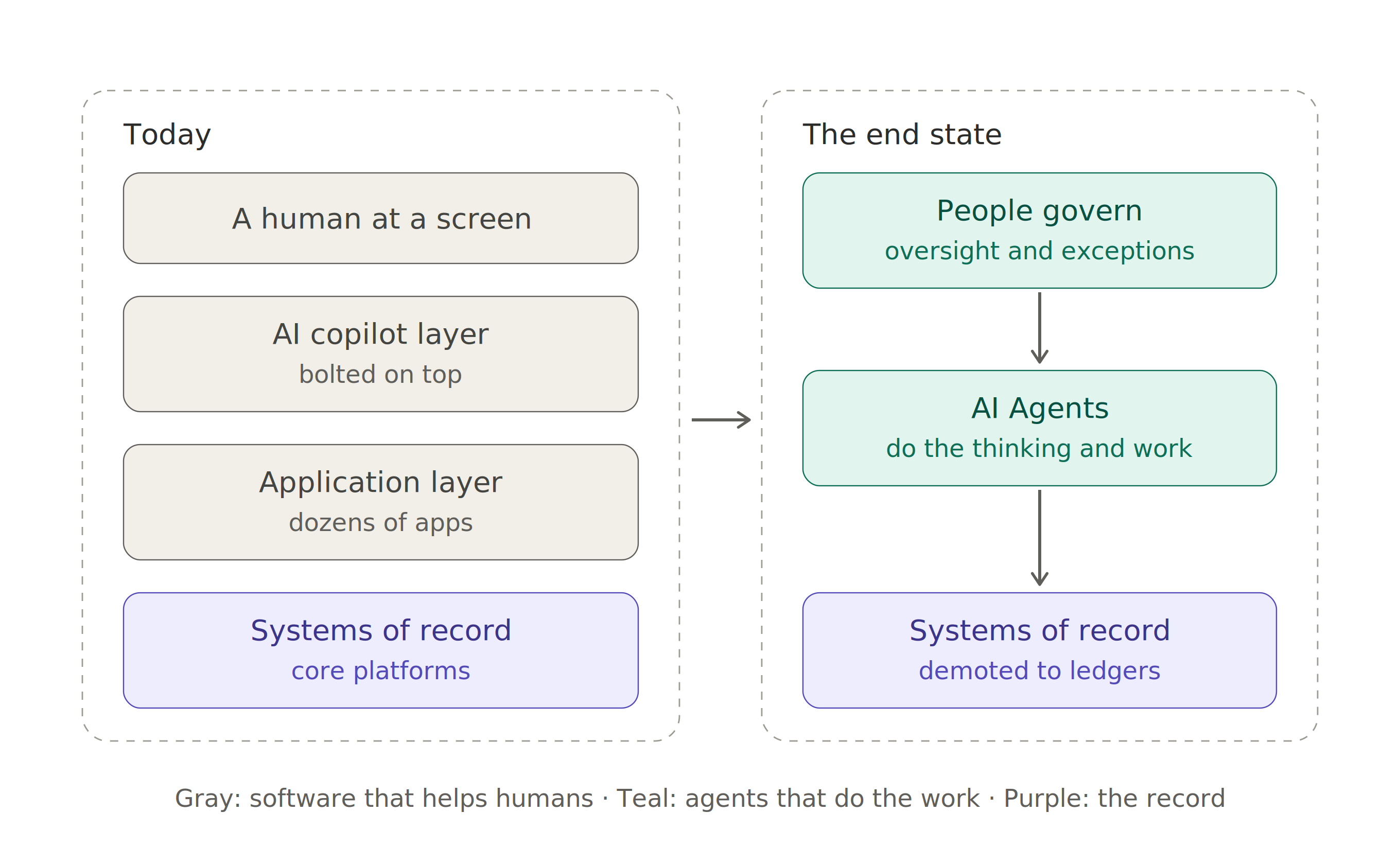
And here is the architectural truth underneath the panic. Today's AI runs as a layer on top of the existing layers. A copilot on the claims system. An assistant in the document tool. An AI feature in the portal. Layer upon layer upon layer, each one preserving the software below it, because the vendor selling you the AI layer is the same vendor whose old layer it should replace. That is not the end state. That is the transitional state. The end state is one layer. Agents working directly against the systems of record, with the entire application sandwich in between gone. All of that software goes away. Not this year. Not without resistance. But the direction is set, and every copilot announcement you read is an incumbent buying time, telling you that you do not need to change anything fundamental, please renew the license.
Don't forget about Frontier Labs, like OpenAI or Antrhopic, who quickly realized, as they should, building just LLMs won't be enough, with properly architected tooling around it they can start to eat out applications on their own - so the game started faster than anyone, including me, anticipated.
It is a delayed transition. I will not argue about the timeline. Delayed is not the same as avoidable. The world we know is changing, and the companies adding AI buttons to thirty-year-old architectures know it better than anyone. That is exactly why they are doing it.
Foundation Capital calls the real prize "services as software" and sizes it at 4.6 trillion dollars, against roughly 200 billion for the SaaS market it replaces. Their comparison: Salesforce earns about 35 billion a year, while companies spend 1.1 trillion a year on the sales and marketing salaries Salesforce was supposed to make productive. The money was never in the tool. It was always in the work.
Insurance is about to feel this harder than most industries, because insurance runs on more filing cabinets than almost anyone.
Every copilot announcement is an incumbent buying time. The end state is one layer, and it is not theirs.
Secret dual problem
Let me give you the numbers, then the history, then the conclusion.
The US Bureau of Labor Statistics now projects that employment of claims adjusters, examiners, and investigators will decline 5.1 percent from 2024 to 2034, and it names the cause directly: AI tools that assess damage and generate payout estimates. That is the government's conservative number, and the government is always conservative on this.
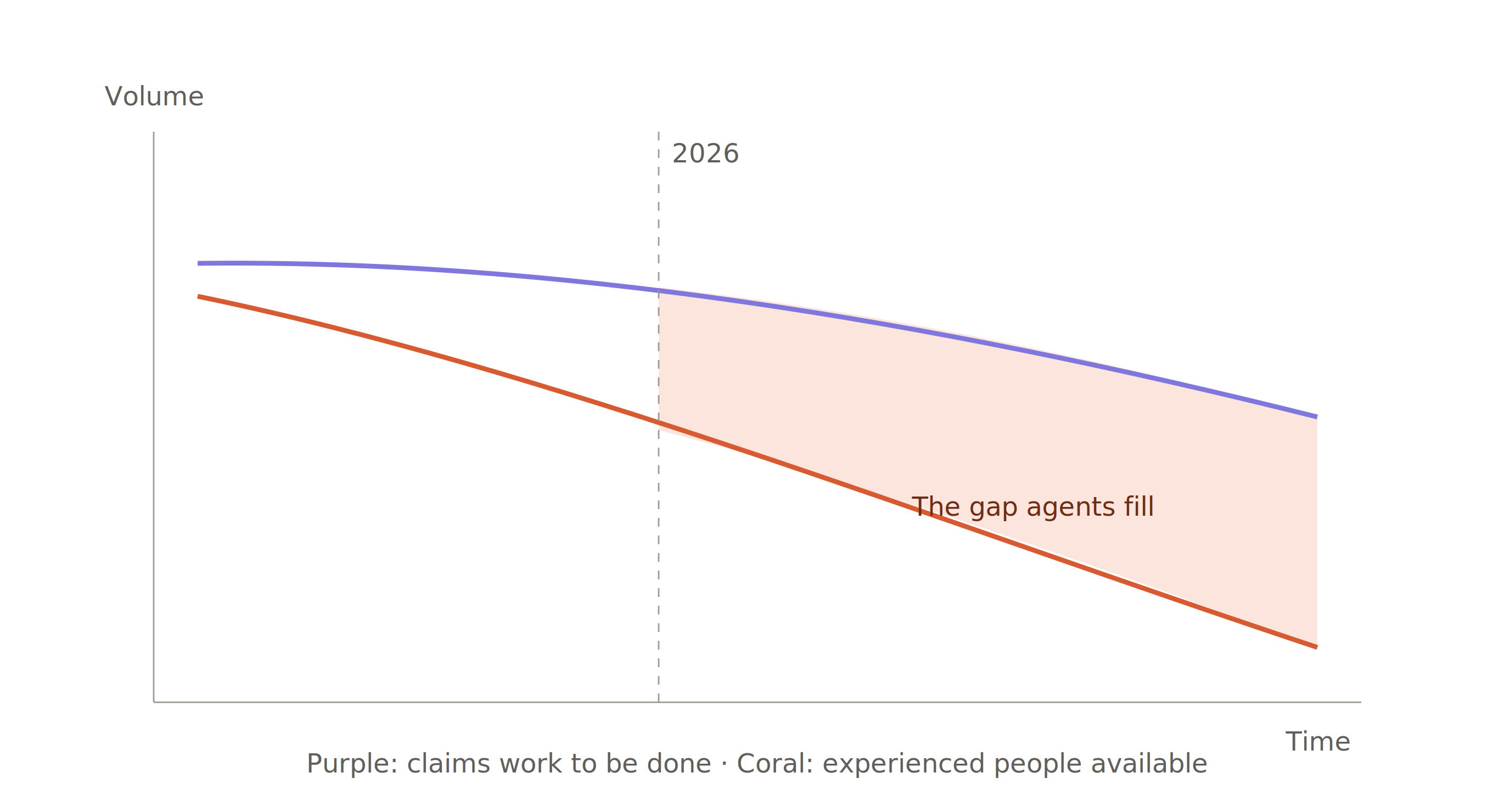
Now the other curve. The US insurance industry is losing around 400,000 workers to attrition through 2026, with about a quarter of insurance professionals at or near retirement age. The people who hold the case experience are leaving. The people who would replace them are not arriving.
I see this curve from the inside, and I will tell you something the statistics undersell. The number one request we hear from customers, almost without exception, is this: help us support growth without hiring. Not because they do not want people. Some genuinely do not, but most simply cannot find them. The experienced adjuster takes six to twelve months to hire if the candidate exists at all. And the loyalty model that built this industry is gone. The handler who once spent 25 years at one carrier, absorbing its book, its quirks, its institutional memory, now stays six and moves on. The knowledge walks out the door on a schedule. Talent is the gap. AI is not creating the shortage. AI is arriving into one.
2 curves are colliding. Demand for human handlers is about to fall because of AI. Supply of human handlers is already falling because of demographics and changed careers. For an early mover, that is not a threat. It is the most humane transition this industry will ever get to run, because attrition can carry most of it. You do not have to fire the experienced people. You have to stop needing to replace them one for one as they leave.
Now the history, because the shape of this matters more than the level. Occupations do not decline in a straight line. They hold steady, and then they collapse, and the collapse comes when the technology crosses a cost threshold.
Telephone switchboard operators peaked at more than 350,000 at AT&T in the late 1940s. The mechanical switching that replaced them was invented in the 1890s. It took decades to deploy. Then, once it crossed the threshold, the job effectively vanished. Economists James Feigenbaum and Daniel Gross documented that after a city cut over to mechanical switching, employment of young women as operators fell by 50 to 80 percent.
Travel agents tripled between 1980 and 2000 to a peak around 340,000. Then airlines cut commissions and the internet arrived. Today the count is down roughly 60 percent from that peak. The job did not erode evenly. It held, and then it broke.
You know the others. Bank tellers. Typing pools. Longshoremen after the shipping container. Agricultural labor falling from nearly half the workforce to a few percent. In every case the curve is flat, flat, flat, then a cliff. The cliff arrives when the unit cost of the machine drops below the unit cost of the human.
Claims handling is approaching that threshold now. An AI Agent that handles a claim end to end has a marginal cost close to zero and does not get tired at 3am during a catastrophe surge. The moment that crosses the line, the curve does what it always does. If you are planning for a gentle 5 percent glide, you are planning for the wrong shape.
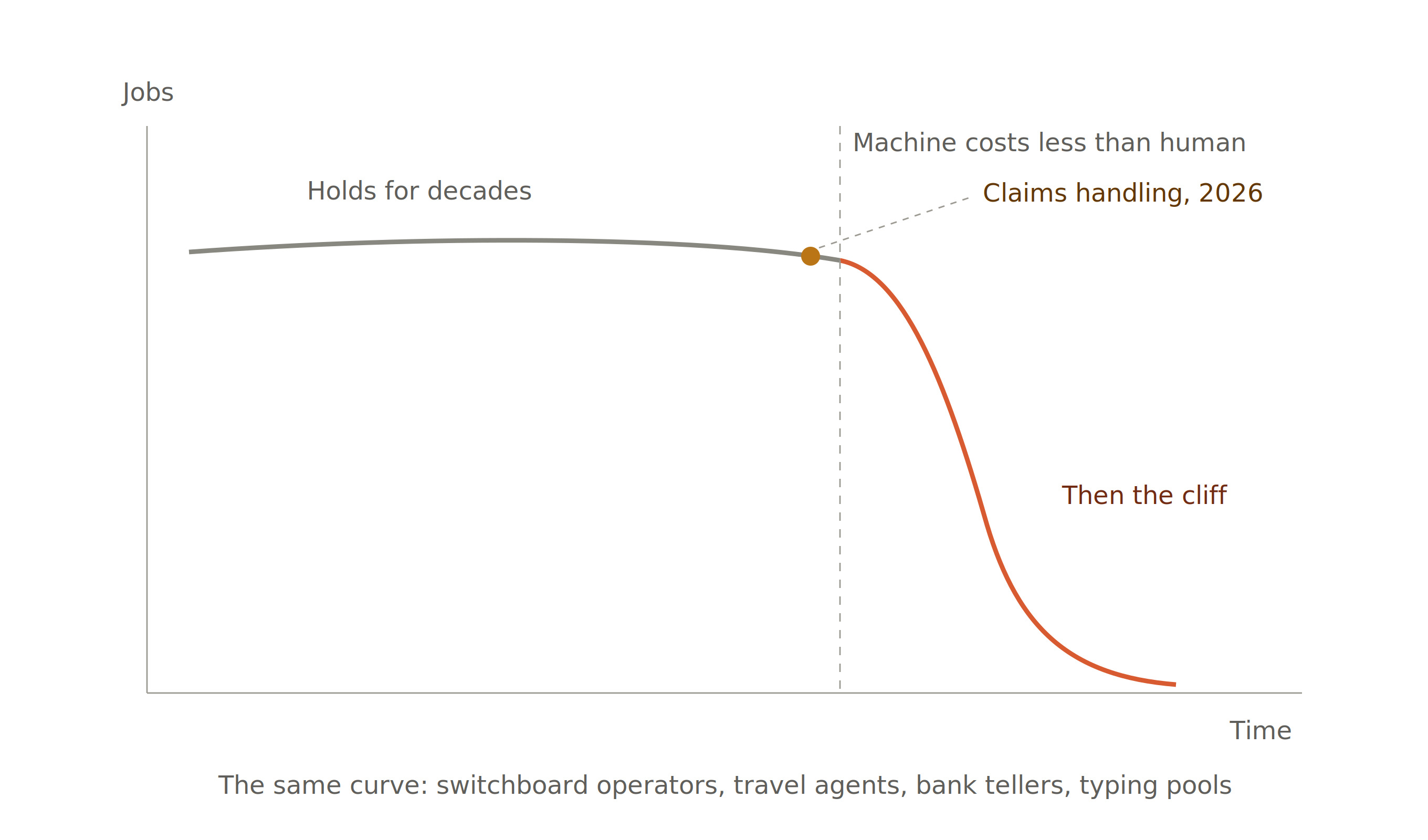
Occupations don't decline in a straight line. They hold steady, then collapse, the moment the machine costs less than the human. Claims is at that line now.
The new job: from doing the work to governing the work
Read this section twice. And let me deal with the obvious objection first, because a careful reader will say I am contradicting myself. The previous section says the occupation collapses. This section says the job gets better. Both are true, and the resolution is simple: the occupation shrinks in number while it rises in seniority. Far fewer people. Far better jobs. The switchboard never produced a smaller, elite corps of switchboard governors. Claims will, because unlike connecting a call, a meaningful share of claims work is judgment and accountability that regulators and customers will not let machines hold alone. The collapse and the promotion are the same event seen from two altitudes.
Start with the analogy that fits best. Airline pilots. Modern aircraft fly themselves for almost the entire flight. The pilot is not there to hold the stick. The pilot is there to hold the responsibility, to monitor the automation, and to take over in the rare, high-stakes moment when judgment is the only thing that works. Aviation learned, at a terrible cost, that this new job has its own failure modes. We are about to learn the same lessons in claims, and we should learn them on purpose rather than by accident.
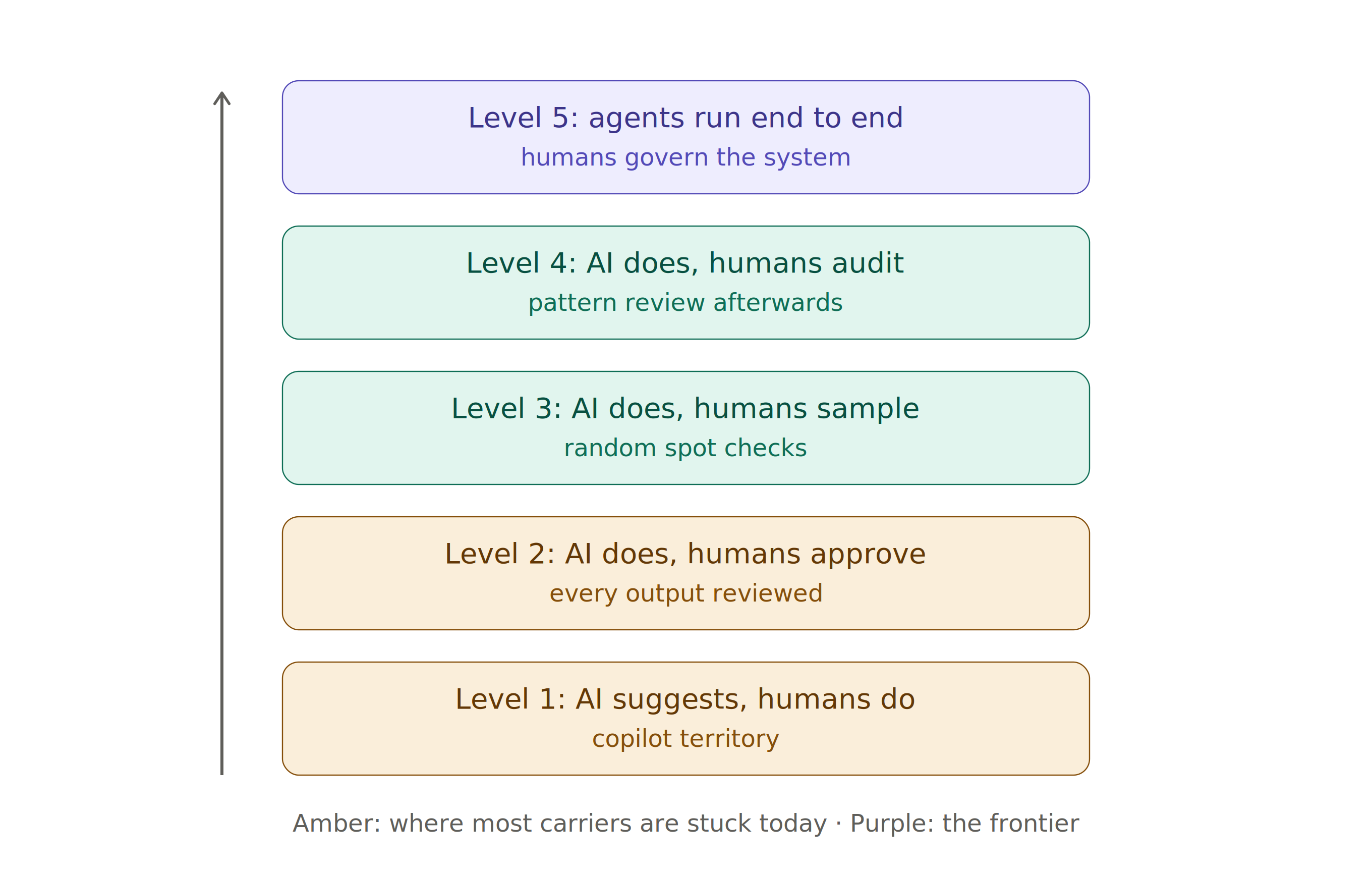
Here is the autonomy ladder every claims operation will climb, whether they plan it or not.
Level one: AI suggests, a human does the work.Level two: AI does the work, a human approves every output.Level three: AI does the work, a human samples a percentage.Level four: AI does the work, a human audits the pattern after the fact.Level five: AI runs the process end to end, including talking to other companies' agents, and humans govern the system rather than the cases. At level five nobody approves a file. People set the policy, define the boundaries, audit the fleet, and answer for it.
Most carriers today are stuck between level one and level two on the few processes they have touched at all. The winners will move trusted segments up the ladder deliberately, segment by segment, with evidence at each rung. Level five is not a fantasy. It is where the subrogation example later inevitably leads to.
What does the job become at the top of that ladder? Consider Allianz. In July 2025 it launched Project Nemo in Australia, an agentic system of seven specialized agents that handles food spoilage claims after storms. Built in under 100 days. It reports around an 80 percent reduction in processing and settlement time. And here is the line that tells you where the job is going. Allianz's transformation lead said human-in-the-loop is a core principle, that the agents recommend, but by design, payout decisions are never automated.
So picture the claims professional in 2030. He does not open files one at a time. He supervises a fleet of agents that have already opened thousands. His screen shows exceptions, confidence scores, and patterns. At 3am during a catastrophe event the fleet flags nineteen files across three regions sharing a billing fingerprint, and he decides in four minutes whether that is fraud or coincidence, a call a traditional team would have taken weeks to even notice was there to make. He spends his real attention on the major-loss claim where a family lost everything, because that conversation is the one no machine should own. And every decision he touches is logged, because the regulator will ask.
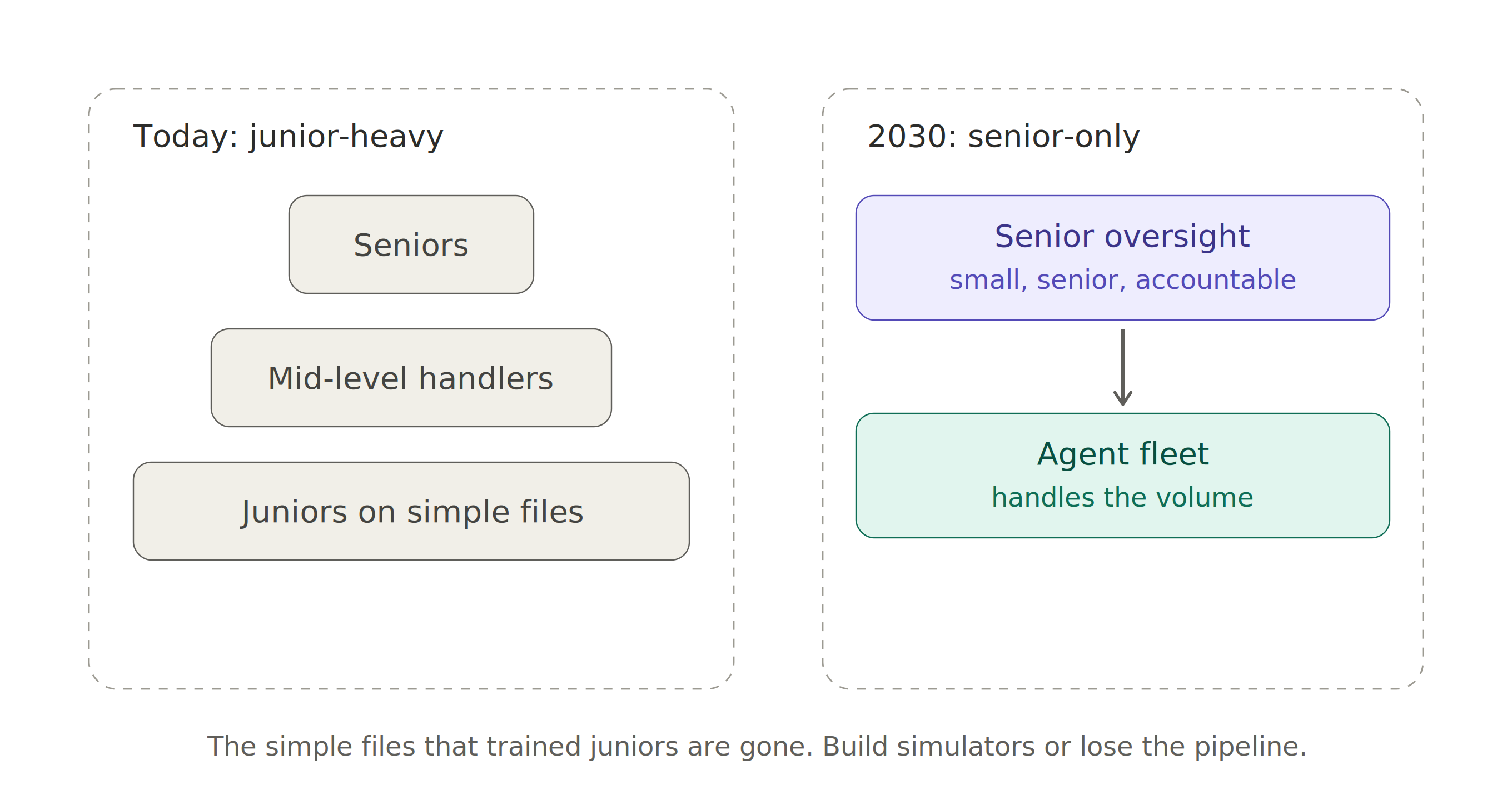
That is span of control applied to software. One supervisor, a fleet of agents, a small number of true exceptions. The experience pyramid inverts. The old department was junior-heavy: many trainees doing simple files, a few seniors handling complexity. The new department is senior-only, because the simple files are gone and what remains is exactly the work that requires the most judgment. The oversight roles command a premium, because they are scarcer and harder. Performance management changes with it. You stop measuring files per day. You start measuring fleet quality: leakage, accuracy, fairness, escalation rates, customer outcomes, audit pass rates.
The new skill stack is different from the old one. Data literacy, to read what the fleet is telling you. Model skepticism, to know when the confident answer is wrong. Escalation judgment, to know which exception is real. And concentrated emotional labor, because when a human does talk to a customer now, it is the hardest 5 percent of conversations, back to back, all day.
Now the two dangers, because anyone who tells you this is pure upside is selling something.
The first is automation complacency. In 1983 the cognitive scientist Lisanne Bainbridge published "Ironies of Automation," and the irony she named is this: the more reliable the automation, the worse the human becomes at exactly the job the automation cannot do, because they never practice it. In 1997 an American Airlines training captain called pilots who could only follow the autopilot "children of the magenta line." Then Air France 447 fell into the Atlantic in 2009. The autopilot disengaged when sensors iced over, the stall warning sounded 75 times, and two trained pilots never executed the recovery they had learned in flight school. The automation had been good enough, long enough, that the skill had atrophied.
A claims operation that automates well will create the same trap. If the AI is right 99 percent of the time, the human who is supposed to catch the 1 percent will stop being able to see it. You design against this on purpose. Rotate people through hard cases. Inject known exceptions to keep the oversight sharp. Treat skill maintenance as a system requirement, not a training afterthought.
The second danger is the broken career ladder, and it is harder. Entry-level work disappears first, because it is the easiest to automate. But entry-level work is how humans used to become senior. If the agents handle every simple file, where does the next generation of senior judgment come from? You cannot govern a fleet at level five if you never learned the work at level one. There is a real risk that the agents accumulate all the case experience, learning from every file, while the humans stop accumulating any.
This is the question the industry has not answered, and the early movers will have to invent the answer: simulation-based training, exception apprenticeships, deliberately routing some learnable cases to juniors even when an agent could do them faster. We taught pilots in simulators because we could not let them learn on full aircraft. Claims will need its own simulators. Build them, or wake up in ten years with a fleet of agents nobody on staff is qualified to govern.
"Far fewer people. Far better jobs. The collapse and the promotion are the same event seen from two altitudes."
The Agentic Insurance System
Now let me show you what this does to your technology estate, because this is where the numbers get vivid.
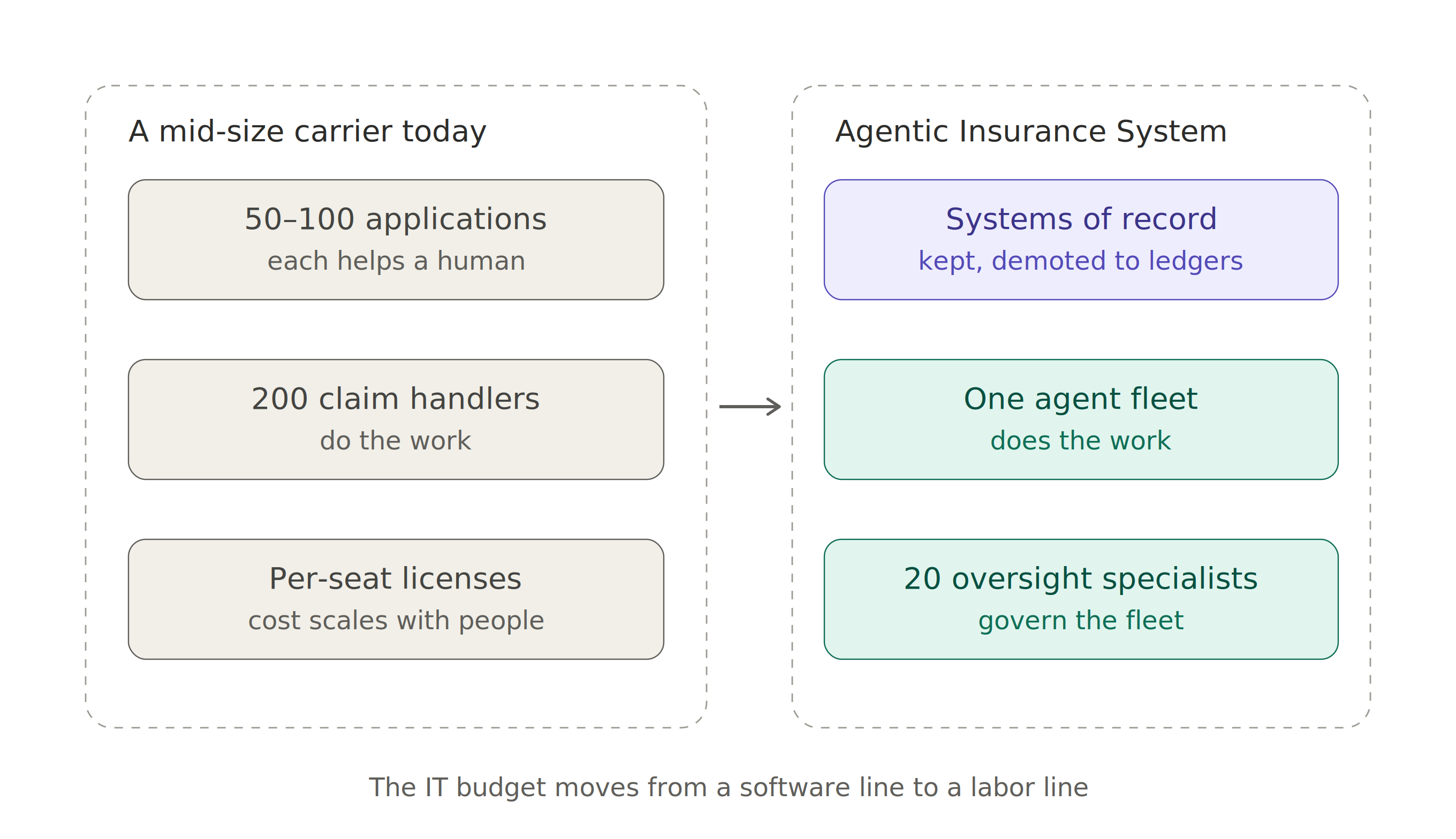
A modern enterprise does not run a handful of applications. Okta's 2025 data puts the average company above 100 apps, with large enterprises around 131. Zylo's 2025 index puts the average portfolio at 275 applications, and at the largest organizations 660 apps and 284 million dollars in annual SaaS spend, with roughly seven new apps arriving every month. An insurer's slice of that is its own zoo: policy admin, claims management, billing, document management, CRM, fraud tools, communication platforms, BI dashboards, portals. Dozens to hundreds of systems. Every single one built to help a human do a task.
Here is the architecture that replaces it. Call it the Agentic Insurance System. The AI operating system for the carrier. And let me be precise about what it eats, because it eats in phases.
Phase one is now. Agents deploy on top of the existing estate. They read from and write to the core systems through connectors, and they start doing the work the applications only supported. The point solutions go first: the intake tool, the document extraction vendor, the triage add-on. An agent that handles the claim does not need a tool that handles a tenth of it.
Phase two, the core platforms get demoted. The Guidewires, the Duck Creeks, the Sapiens, the Keylanes, the legacy mainframes stop being the place where work happens and become what Nadella said they would become: databases. Transaction ledgers. The canonical record of what is true. Nobody logs into them, because there is nobody to log in. The agents are the workers and the interface. The screens, the workflows, the modules, the configuration empires built on top of those platforms, all of it stops earning its license fee. A system of record priced as a system of work is a renegotiation waiting to happen.
Phase three, even the record layer gets contested. Once agents do all the work, the question becomes why the ledger underneath them must be a thirty-year-old platform priced for an era when it was the whole operation. Agent-native systems of record will appear, built for machine throughput instead of human screens. I will not put a year on phase three. I will say the direction is one way. The Agentic Insurance System eats all of the software relevant to insurance operations. Not some. All. In phases, with resistance, over years. But all.
How can agents handle something as complex as a full insurance operation? Not with one giant model trying to be everything. That is the wrong mental picture. The right architecture is the one Allianz's Nemo already shows in miniature: specialized agents per domain, an orchestration layer that coordinates them, tool use through connectors, and human escalation at the decision points that matter. Anthropic's Model Context Protocol, launched in late 2024, standardizes how an agent reaches a tool or database. Google's Agent2Agent protocol, launched in April 2025 with more than 50 partners and now under the Linux Foundation, standardizes how agents talk to each other. The plumbing for this is being laid right now, in the open, by the largest technology companies on earth.
Do the math for a mid-size carrier. Say you run 50 to 100 claims-related applications and 200 handlers. The Agentic Insurance System collapses that to three things. Your systems of record, which you keep for now. A fleet of agents orchestrated over them, which does the work. And perhaps 20 oversight professionals who govern the fleet. The IT department stops managing applications and per-seat licenses and starts governing agents and per-outcome costs. The budget moves from a software line to something closer to a labor line, which is exactly why this market is an order of magnitude bigger than SaaS ever was.
Now the frontier question, the one that should genuinely change how you think. Could agents settle claims directly between two insurance companies?
Look at the volume hiding in plain sight. Arbitration Forums, the US not-for-profit that handles inter-insurer disputes, reported almost 1.2 million arbitration disputes and 2.4 million subrogation demands in 2024, collectively worth over 26 billion dollars. The industry rule of thumb puts the subrogation cycle around 200 days from identification to recovery, even though the final payment itself takes about ten. The delay is not the money. The delay is the process: the evidence packages, the negotiation, the waiting. Europe has its own machinery: France runs most motor claims through the IRSA and IDA inter-insurer conventions with a fixed liability scale; the UK runs the ABI's General Terms of Agreement, which added compulsory arbitration in 2024 and 2025 specifically to cut frictional cost.
Every one of those processes is two companies exchanging evidence, applying agreed liability rules, and settling. That is precisely the structured negotiation agents are built for. Now extend the line. Two carriers' agents, speaking a shared protocol, exchange the evidence, apply the liability scale, and settle a subrogation claim in minutes instead of 200 days. That is level five on the autonomy ladder, and it is not science fiction. The protocols exist. The volumes are enormous. The only missing pieces are will and a trust framework. Whoever builds that framework first takes cost out of the system that has been stuck there for fifty years.
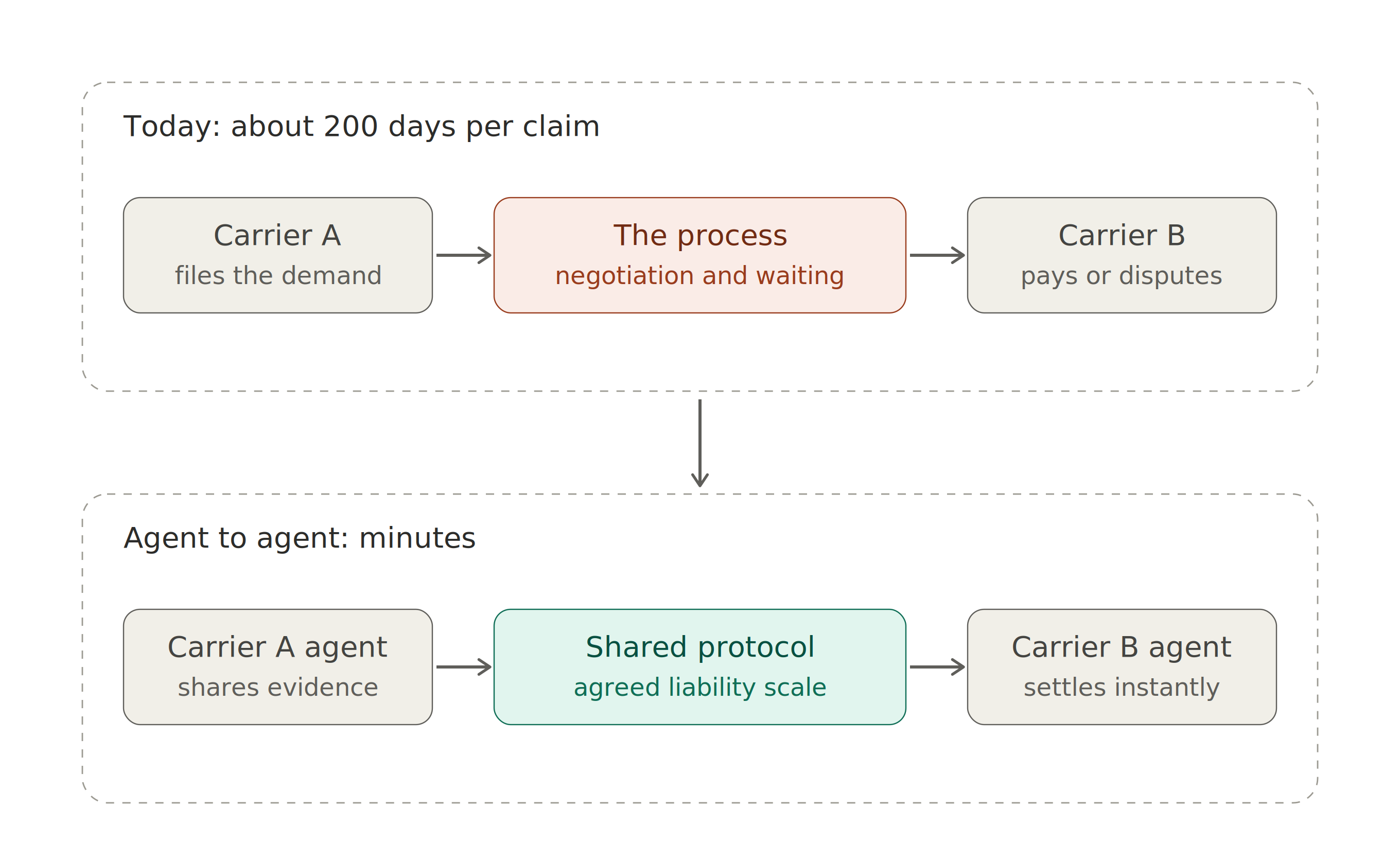
"The subrogation cycle runs about 200 days, but the payment takes ten. The delay is not the money. The delay is the process. Agents settle process."
What it does to the business of insurance
Strip away the technology and ask the only question that matters to a CEO. What happens to companies?
Here is the blunt version: whoever wins the combined ratio game rules the industry, and then buys everyone else.
Walk the dollar. Of every premium dollar, roughly 65 to 70 cents goes to losses, 12 to 15 to acquisition, 12 to 14 to operations, and 3 to 5 cents is margin. Now put agents against that structure. Operations cost collapses toward the cost of compute plus a small oversight team. Leakage, which industry estimates put between 6 and 14 percent of claim payments, gets squeezed by consistency no human team can match. Fraud detection runs across every file instead of the files someone had time to look at. Cycle times drop from weeks to minutes on the routine book. Aviva's AI transformation of motor claims cut complex liability assessment by 23 days, improved routing accuracy 30 percent, reduced complaints 65 percent, and saved more than 60 million pounds in a single year.
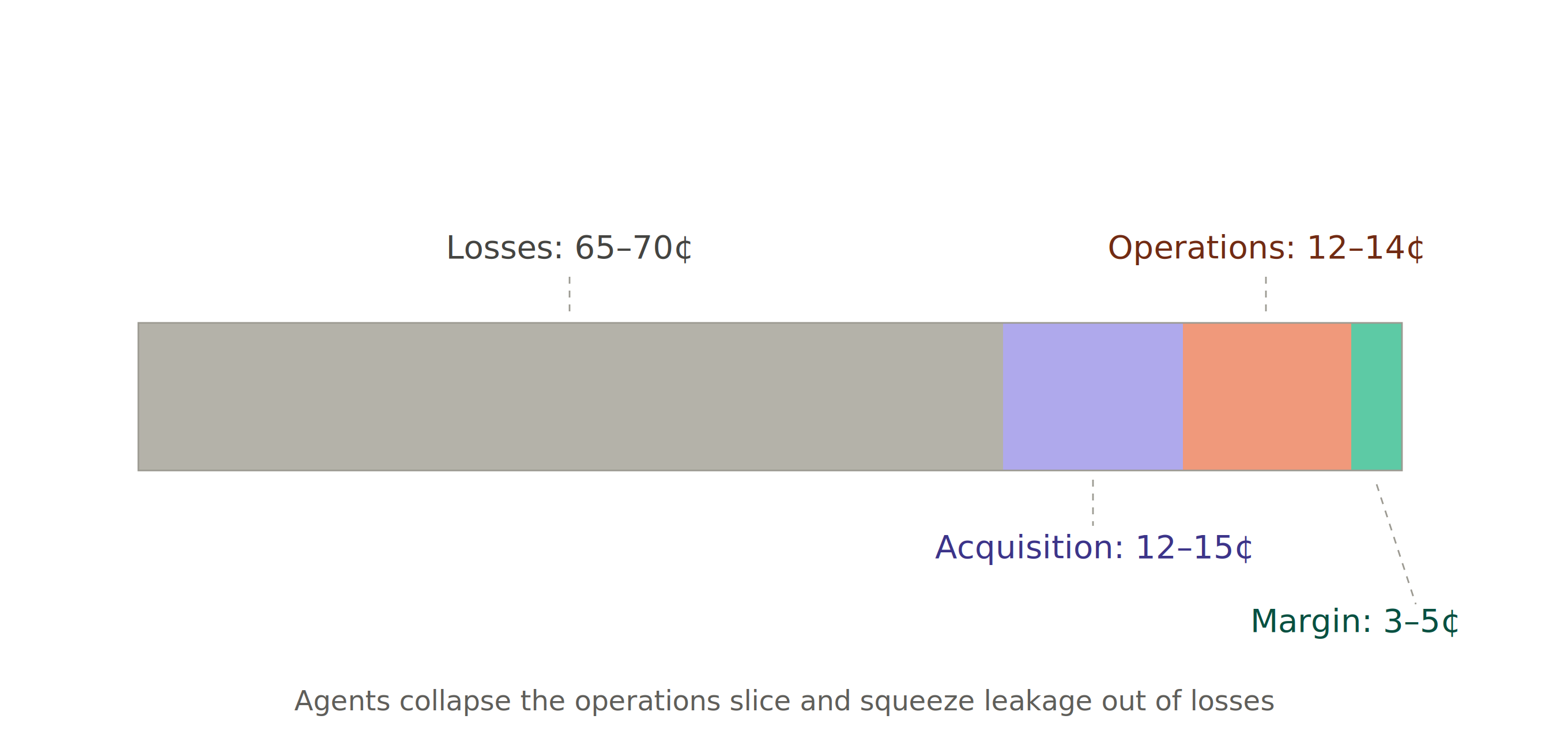
Each of those moves the combined ratio by fractions of a point or whole points. A few points of combined ratio is not a rounding error. For a mid-size carrier a single point is worth millions to tens of millions a year. And here is what the winner does with it: underprice the competition while keeping the same margin. That is pricing power. Pricing power in insurance attracts good risks. Good risks lower the loss ratio. A lower loss ratio funds more advantage. The flywheel turns, and McKinsey already measures the gap: AI leaders in insurance generated just over six times the total shareholder return of laggards, double or triple the leader premium seen in most other sectors.
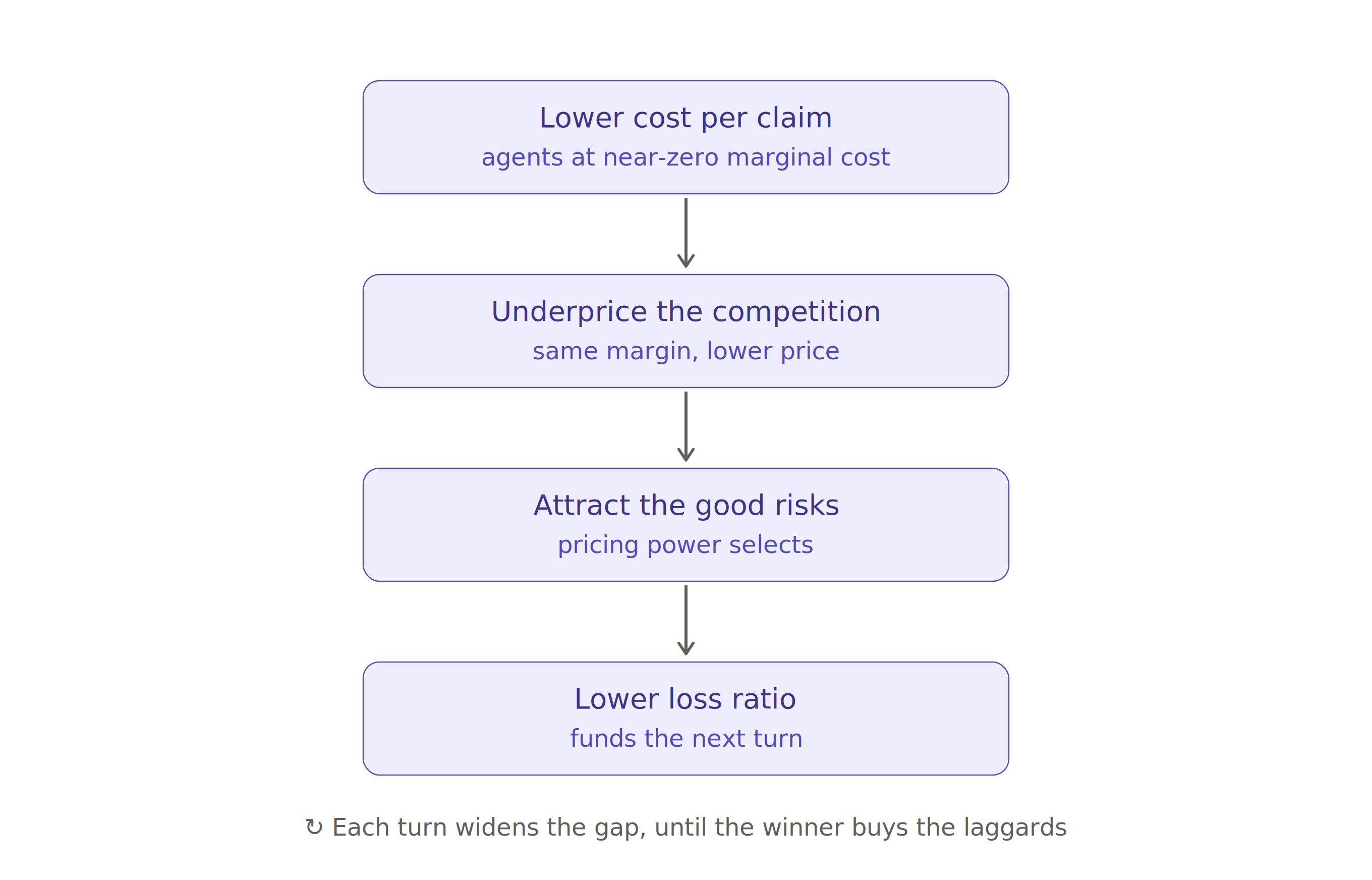
The winner gets more than cost. Near-zero marginal cost of claims capacity means absorbing a catastrophe surge without surge staffing. New products become possible: parametric-like speed on traditional covers, embedded insurance with instant claims, micro-claims that were never economical to touch by hand, usage-based products with real-time settlement. And every agent-handled claim produces structured decision data that feeds underwriting in a closed loop, instead of dying in an adjuster's free-text notes.
Now the loser's path, because it is just as mechanical. A carrier that cannot move its expense ratio faces the spiral: higher costs force higher prices, higher prices drive adverse selection as the fast, cheap competitor skims the good risks, the loss ratio deteriorates, the best people leave for the winners, and the board eventually faces the menu nobody wants: sell the book, go into runoff, or be consolidated. This is how the combined ratio game ends. The winners do not just outperform the losers. They acquire them, at distressed multiples, and migrate the books onto their agent fleets at marginal cost. Consolidation is not a side effect of this transition. It is the prize.
There is a build-or-rent decision buried here that belongs in the boardroom, not the IT steering committee. Billions are flowing into agentic AI, and AI-native third-party administrators are being funded specifically to take this work off carriers who will not move. If you do not build or buy the capability, someone will rent it to you, and they will own the operational intelligence that comes with it. That is the asset. Not the model. The accumulated intelligence of millions of decisions.
What it does to customers
Insurance is a promise. The promise is invisible until the day a claim is filed, and then it is the only thing that matters. Today that moment is too often bad. Handlers buried in admin. Leakage and fraud taxing every honest policyholder. A bad claims experience remains the fastest way to lose a customer for life.
Done right, agents fix the experience, not just the cost. The claim is acknowledged instantly. Coverage confirmed in seconds. The simple claim paid before the customer puts the phone down. The human shows up exactly where a human should: the complex loss, the grieving family, the case that needs a person to care.
But here is the dimension almost nobody is planning for. The customer is about to get her own agent.
Today most first notices of loss still arrive through unstructured human channels, phone calls and emails and PDFs, and a large share of manually completed forms arrive with errors. The interaction model is the customer navigating your portal or waiting in your phone queue. That model is about to flip. OpenAI's Operator already books and buys on a person's behalf. The Agentic Commerce Protocol from OpenAI and Stripe lets agents transact with businesses. McKinsey sizes agentic commerce at 3 to 5 trillion dollars by 2030.
Extend that to claims. Your customer's personal agent files the FNOL, with complete data, structured, the moment the loss happens. It negotiates. It chases status. It escalates when you are slow. It talks to your agents machine to machine for everything routine, and the customer reads a summary over coffee. She never logs into your portal. She never calls. And her agent keeps score. If your operation still runs on a human typing into a screen while her agent waits, you are the slow, expensive party in a negotiation between two machines, and her agent will remember that at renewal, comparing you against every carrier whose agents settle in minutes.
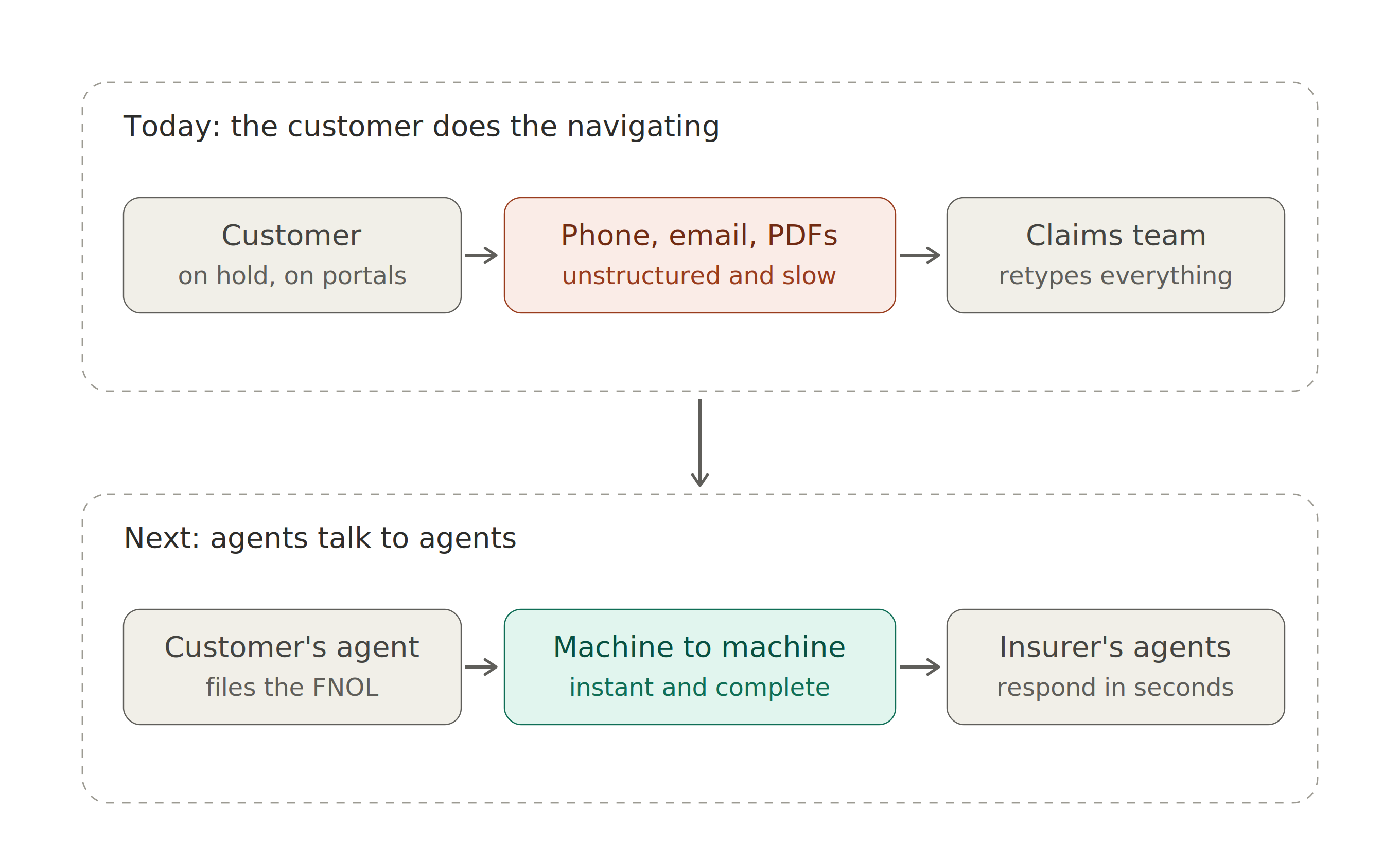
There is a dark version of this future, and I will name it, because pretending it does not exist is how an industry sleepwalks into it. Agents make it trivially easy to deny claims at scale. The US has already produced the cautionary tales. Cigna was sued in 2023 over a system that plaintiffs allege denied over 300,000 claims in two months, averaging about 1.2 seconds per claim. UnitedHealth was sued over an algorithm with an alleged 90 percent reversal rate on appeal, and in February 2025 a federal judge let breach-of-contract claims proceed. That is the warning. An agent that does the work can keep the promise faster than ever, or break it faster than ever. Which one you build is a choice, and increasingly a regulated one.
"Your customer's agent will file the claim, chase you, and escalate when you're slow. If you still run on a human at a screen, you're the slow party in a negotiation between two machines."
The three-speed world: America, Europe, and the ones who won't wait
This transition is global, but it will not run at one speed, and the speed differences are themselves a strategic fact.
In the United States, the pressure is market-driven and the regulation arrives state by state. The NAIC Model Bulletin on insurers' use of AI covered 24 states by August 2025 and more than half the country by early 2026, with Colorado, New York, California, and Texas going further on their own. The real discipline is competitive and legal: the carrier across the street moving faster, and the courtroom, as the Cigna and UnitedHealth cases show. America will adopt fast because America punishes slow.
In Europe, the pressure is demographic and the regulation is structural and ahead of the market. The EU AI Act's high-risk obligations apply from August 2026, with fines up to 35 million euros or 7 percent of global turnover, and EIOPA's August 2025 opinion lays out governance expectations across the AI lifecycle. Europe's markets are fragmented, multilingual, and judgment-heavy, exactly the environment where agents create the most value, and Europe's labor math is the least forgiving on earth.
I have argued, and still argue, that Europe's regulation is a product specification, not a brake. The AI Act demands human oversight, traceability, explainability. That is the oversight architecture from four sections ago. Build oversight-by-design and you satisfy Brussels and inoculate yourself against the American class action in the same move. Oversight is not the cost of doing this. Oversight is the product.
But honesty requires the other scenario. What if Europe overregulates and America simply runs ahead? It can happen. If compliance burden in Europe makes every agent deployment a two-year legal project while a US carrier ships in a quarter, the six-times shareholder-return gap between AI leaders and laggards becomes a gap between continents. European carriers would then face American and global competitors with structurally lower combined ratios entering their markets, or buying into them. Regulation that was meant to protect European policyholders would have delivered them to foreign balance sheets.
And the race is not bilateral. Look east. Ping An already settles simple motor claims in minutes through AI-driven self-service and reports that AI handles the large majority of its customer service volume, at a scale no Western carrier approaches. China's insurers operate with regulatory regimes that move at a different cadence and with home markets large enough to fund the learning curve. Add the global reinsurers, the AI-native TPAs, the big tech platforms with agent protocols and distribution. The combined ratio game has more players than Brussels and Washington.
Here is the uncomfortable game theory. The only world in which slow is safe is a world where the entire industry agrees to slow down together. That world does not exist. There is no OPEC for claims automation. Any individual carrier, any individual market, that waits is making a bet that everyone else waits too, and that bet loses to the first defector. Many companies are in danger not because the technology is risky, but because their pace assumes a truce nobody signed.
One more asymmetry, and it is irreversible. Where do the displaced people go? Some to adjacent roles: fraud investigation, customer success, risk consulting, insurtech, the public sector. Much of the transition rides on natural attrition, especially for early movers, because the retirement wave is already pulling people out. But once the training pipeline breaks, once the apprenticeship model dies, once a generation does not enter, the capability does not come back on demand. It is gone the way manufacturing know-how left when it was offshored. This is a one-way door for workforce capability. You can automate and deliberately keep the ability to train humans, or you can automate and let it wither. The first is a choice. The second is what happens if you do not choose.
"There is no OPEC for claims automation. Waiting is a bet that everyone else waits too, and that bet loses to the first defector."
Beyond 2030
Let me go further out, and let me be honest about the uncertainty, because anyone who is certain about 2030 is lying to you.
There is a scenario worth reading called AI 2027, written by Daniel Kokotajlo, Scott Alexander, and colleagues at the AI Futures Project. It forecasts a progression of increasingly capable agents, through systems that automate AI research itself, toward an intelligence explosion, with research progress multipliers the authors model at 4x, then 25x, then 100x and beyond. They wrote two endings, one a managed slowdown, one an uncontrolled race, and they are explicit that it is a scenario, not a forecast, and that capability could plateau. I treat it as one credible scenario in a family of them. But you do not need the dramatic version to be true for the implications to land here. You only need the capability curve to keep bending the way it has bent for three years.
If it does, the question stops being "how many handlers do we need" and becomes "what is an insurance company." Strip a carrier to its essence and four things remain: capital, a license, a brand, and an agent fleet. Everything else is implementation. Two of those four, capital and license, are commodities. Brand is rented trust. The agent fleet, and the operational intelligence compounding inside it, is the only one of the four that improves every single day. Draw your own conclusion about where value concentrates.
The product itself shifts under your feet. Insurance has always been post-loss indemnification: something bad happens, we pay. Continuous sensing, prevention-first models, and parametric-everything point toward real-time risk management instead. The claims event itself shrinks. Autonomous vehicles, if they deliver, cut accident frequency dramatically. The smart home catches the leak before it floods the kitchen. Predictive maintenance stops the failure before the loss. A meaningful share of the claims department's future workload simply never happens. Insurance moves from processing claims to orchestrating risk, and the human role consolidates into the functions regulators will never let a machine hold alone: governance, ethics, final accountability.
Picture the end state honestly. The customer's agent, the carrier's agents, and the reinsurer's agents form a continuous negotiation mesh, pricing, settling, and adjusting in something close to real time. Risk is sensed, priced, and partially prevented before it matures into loss. The humans sit above the mesh, accountable for it, governing it, answering for it. The org chart called "the claims department," the floor of desks, the queue, the cost center, does not exist in that world. What exists is a governance function staffed by the most senior operational minds in the company.
The futures range from a managed transition that moves people into better jobs to a disorderly displacement that does not. Which one we get is not decided by the technology. It is decided by the choices leaders make in the next 36 months.
What we are building, and why
A short word on Simplifai, because you have earned the right to know where I stand commercially, and because the plan is the argument.
We build AI Agents for insurance, and we are building them into an Agentic Insurance System, with the synergy between AI and humans designed in from the start. That was always the plan. Not a copilot on the cabinet. Not a point solution starting another small fire. Agents that do the thinking and the work, governed by people, on an architecture built for the autonomy ladder, with the oversight, audit trails, and explainability the regulators demand already in the foundation, because we believe oversight is the product.
It works. In production, today. There are big challenges, it's not easy, but we solving it one at a time. Each customer that trust us get faster to the future state, our product get better, next experience improves and cycle continues. We have taken claim intake at a carrier from 24 hours to 2 minutes. We have taken an end-to-end claims process at another from 30 days to under a minute. We run intake automation above 97 percent for a claims operation of 400 handlers. I will not name the companies here; the named references are on our site. The point is not the logos. The point is that the future I describe is not a forecast for us. It is a roadmap we are already executing, claim by claim, carrier by carrier, level by level up the ladder.
We approached it from the 1st principle perspective. We stripped each function and related job, like claim handling, to a list of tasks that has to be performed in order to successfully execute 1 business transaction. Then we stated to figure out what AI Agent should do for each task: some become automation scope, some tasks will change, but stays with human. We call it Agentic People Enablement. Later we started trying to run entire sequence of claim E2E, hence offering to our customers real Agentic Experience. Some are more open, some more careful. We understand and do not apply pressure - we let customer choose the model that make more sense at the current stage of maturity. AI Agent can be used for traditional Automation, can enable people do their job much better or can do entire job E2E - act as capacity extension.
Simplifai Platform is transforming to a new type of software = Agentic Insurance System. AI Agents think and work through it.
What to do on Monday
Enough theory. Here is the sequence, and the order is not negotiable.
First, automate the work. Deploy agents on your highest-volume claims processes now. Not a copilot. Not an "ask AI" button. Agents that do the work end to end on a bounded, well-understood segment, the way Allianz scoped Nemo to food spoilage under a clear threshold. Start where volume is high and judgment is low. Prove it.
Second, enable your people. Redeploy and retrain your best handlers into oversight roles before you need them there. Build the simulators and the exception apprenticeships now, while you still have seniors who can teach. This is the step everyone skips, and it is the step that determines whether your transition is humane or brutal.
Third, and only third, let agents run trusted segments end to end. Climb the autonomy ladder one segment at a time, with evidence at each rung, oversight designed in, and a human holding the decisions that must stay human. Never automate the payout decision on a major loss just because you can. That is not where the value is, and it is exactly where the lawsuit is.
And do not wait. Not for the next budget cycle, not for the core migration to finish, not for a competitor to prove it first.
Now the part I actually need to say, because the strategy is the easy bit and the blocker is human.
I talk to claims leaders constantly. The fear is always the same, and it is rarely spoken in a meeting: "My team will resist. And if something goes wrong, it is my career." That fear is real and I will not wave it away. But it is pointing the wrong way. The career risk is inverted. The leaders who master agent operations become the most valuable executives in this industry, because they will be the only ones who know how to run a claims operation that actually scales. The leaders who wait become the executives whose operations get consolidated into someone else's. You are not protecting your career by waiting. You are ending it slowly.
The other blockers are just as human. You are too busy running the business to start. You are waiting for someone else to move first so you can copy them safely. And you are stuck in pilot purgatory, the real industry disease: most carriers have adopted AI in some form, and only single digits have scaled it into claims operations. A pilot that never ships is not caution. It is decline with a project plan.
Here is why waiting is the expensive option. The EU AI Act's high-risk obligations land in August 2026. The retirement wave is pulling your experienced people out right now. Every month a competitor runs agents in production, they accumulate operational intelligence you can never buy back, because it was learned from their files, not yours. And the capability curve, on every credible scenario, is getting steeper. Compounding works for them and against you, monthly.
Your real job, the job to be done, is not "implement AI." It is this: protect your company's promise and your own relevance through the biggest operational transition in the history of this industry. That is a job worth doing well, and it is a job that cannot be done from the sidelines.
The last claims handler will not be made redundant. She will be promoted. He will stop opening files and start governing a fleet that does. They will be the most senior, most trusted, most accountable people in the building, because they will hold the judgment and the responsibility no machine is allowed to hold.
The only question is whether they work for you, or for the company that consolidated you.