
European Accident Statement Reader: from physical form to structured claim data
AI reader for European Accident Statements turns handwriting and sketches into structured claim data, surfacing discrepancies with field-level confidence.
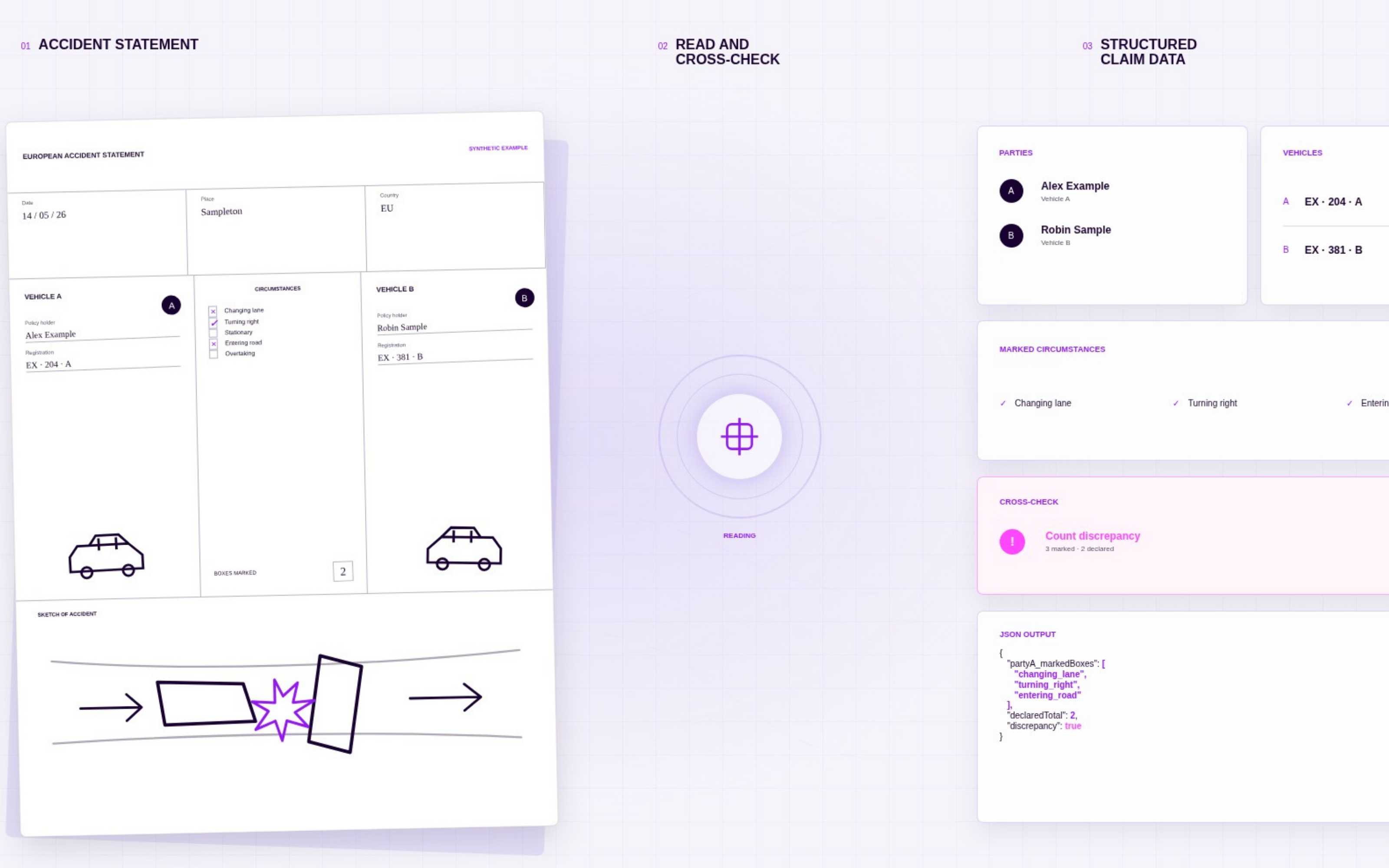
A physical accident statement can describe the same collision in several different ways. The European Accident Statement Reader, available within Simplifai’s AI Agent for Claims, transforms that information into structured claim data and surfaces where the form contradicts itself.
The European Accident Statement Reader processes information from the form, cross-checks its different representations and returns structured claim data. Visual shown is a simplified representation.
One accident. Three versions of what happened.
The European Accident Statement captures a collision through marked circumstance boxes, the number of boxes each driver declares and a hand-drawn sketch.
Those three representations do not always agree.
The boxes may indicate one sequence of events while the sketch suggests another. The number a driver says they marked may not match the number actually selected. Information recorded by the two parties may also conflict.
Identifying those discrepancies during claims intake ordinarily requires someone to read both sides of the document, interpret the handwriting and compare each part of the form manually.
The European Accident Statement Reader is purpose-built for that task.
From physical statement to structured claim data
The Reader processes both sides of a physical European Accident Statement, including documents received as scans, photographs, faxes or carbon copies.
It extracts identification information and reads the 17 circumstance boxes for each party separately. It then cross-checks:
- the boxes marked by each party
- the total each driver declares
- the hand-drawn accident sketch
- the accounts provided by both parties when they appear on the same form
Where these representations disagree, the Reader surfaces the discrepancy rather than leaving it buried within the document.
The result is structured claim data, including JSON output that can be used within downstream systems and workflows.
Built for the document, not just the text
Accident statements present a particular extraction challenge. Their layout is consistent, but the information entered into them is not.
Handwriting, image quality, carbon copies and roadside photographs can all make the content difficult to interpret. The Reader uses the form’s established structure to identify where information belongs and what it represents.
This makes the capability multilingual by design. It works from the consistent structure of the document, supported by market-specific claims knowledge, rather than relying only on the language used to complete it.
Confidence where it matters
The Reader returns a confidence level for each extracted field.
Instead of treating the whole document as equally certain, it shows where the extracted information is clear and where closer attention may be useful. Claims operations can then work with structured information while retaining visibility of uncertainty at field level.
Supporting decisions, not making them
The European Accident Statement Reader does not determine liability.
It gives the claims operation a structured account of what appears on the form and makes internal discrepancies visible. The decision remains with the insurer and its established claims process.
“This is the form that decides who pays,” said Fernando Cristóvão, Chief Technology and Product Officer at Simplifai. “Two drivers fill it in at the roadside, in whatever language they have, and in some European countries the law then presumes it is true. The layout never changes. The handwriting always does. So we engineered for the part that is fixed. The system reads both sides, counts the boxes the drivers said they marked, looks at the drawing, and shows where those three things disagree. It scores every field, so a handler checks four instead of forty.”
Questions about the European Accident Statement Reader
Can AI read a handwritten European Accident Statement?
Simplifai’s Reader processes scans, photographs, faxes and carbon copies of both sides of the form, extracting information from handwriting, marked boxes and the accident sketch.
What happens if the sketch and the marked boxes disagree?
The Reader flags the discrepancy and shows confidence for individual extracted fields so the claims team can review uncertain information.
Does the Reader decide who caused the accident?
No. It produces structured claim data and highlights inconsistencies. Liability decisions remain with the insurer and its claims process
Available within Simplifai’s AI Agent for Claims
The European Accident Statement Reader is available as an intake capability within Simplifai’s AI Agent for Claims.
It extends the Agent’s ability to process incoming claims information, transform unstructured documents into usable data and support the next stage of the claims workflow.
Explore Simplifai’s AI Agent for Claims.