
Human in the loop: Synergy of AI Agents and Humans
Simplifai has launched next-generation Human-in-the-Loop across its Agentic Insurance System — turning oversight from a single review screen into a configurable platform primitive that carriers can call at any checkpoint in the claim lifecycle, with full traceability on every decision.
Major Product Update: Simplifai launches next-generation Human-in-the-Loop across the Agentic Insurance System — the configurable interface where humans and AI Agents work together at every stage of the claim lifecycle The new release turns Human-in-the-Loop from a single review surface into a configurable platform primitive. AI Agents can call it at any point in a workflow, with carrier-defined actions, full traceability on every decision, and the same building block ready to power use cases beyond claims as the Agentic Insurance System expands across the insurance value chain.
Miami, FL & Oslo, Norway — May 28, 2026 — Simplifai today announced a major product update to the Simplifai AI Platform: the next generation of its Human-in-the-Loop (HITL) capability. The release transforms HITL from a fixed review screen into a configurable platform primitive — the interface through which humans and AI Agents work together at any point across the claim lifecycle, with the actions, checkpoints, and oversight model defined by the carrier, not the tool.
This is the second in a series of major product updates Simplifai is publishing through 2026, following the May launch of next-generation Document Intelligence.
Synergy, not substitution — and the carrier decides where the line sits
The premise behind the Agentic Insurance System has always been that AI Agents and people do their best work together. AI Agents handle volume, repetition, and pattern. Humans handle judgment, empathy, and the moments that matter. The interface between them is where most claims AI either succeeds or quietly fails.
Next-generation HITL is that interface, rebuilt as a building block the carrier controls.
The carrier defines where humans are inserted into a workflow. The carrier defines what actions a reviewer can take at each checkpoint. The carrier defines what an AI Agent is allowed to do autonomously and where it must wait for a person. Nothing the AI Agent does goes unrecorded. Every decision, every correction, every approval — logged, attributed, timestamped, and available for audit.
What "next generation" means
The previous generation of HITL — across the industry, not just at Simplifai — was a single review screen bolted onto a single use case, usually document extraction. The reviewer got a fixed set of actions. The checkpoint sat at one place in the workflow. Anything more required a separate tool, a separate UI, and a separate audit trail.
The next generation is a configurable, reusable building block. Same primitive, called wherever the carrier's process needs it, with the actions the carrier defines.
What this looks like in practice:
- Composable checkpoints. Any AI Agent can call HITL at any point in its workflow — intake, extraction, coverage decision, assessment, communication, fraud triage, payment, closure. Multiple checkpoints in one workflow, each with its own actions.
- Configurable actions. Carriers define the actions available to reviewers at each checkpoint. Approve, Reject, Send back, Escalate, Reassign, Request more information, route to a specific team — or any custom action the process requires. The action both branches the workflow and updates the data the next steps will consume.
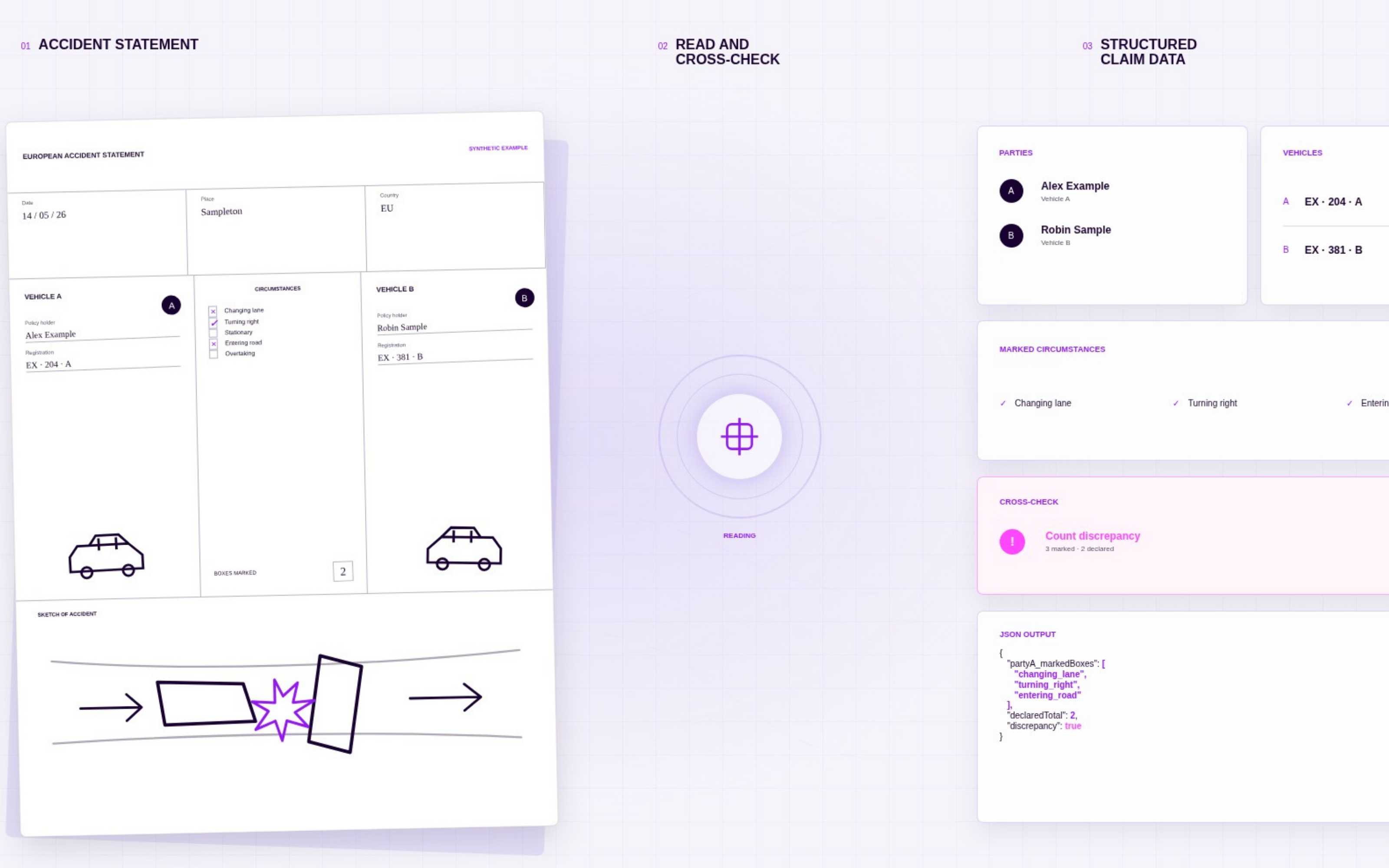
- Side-by-side review. Original documents on one side, AI Agent predictions and confidence scores on the other. Reviewers correct, reclassify, reconcile, and decide in one screen.
- Entity unification across the claim file. Reconcile the same field across multiple documents in one step. The single reconciled value flows downstream.
- Full traceability on every action. Reviewer identity, timestamps, the chosen action, before/after data — logged on every review and available across the flow.
- Platform-native, not bolted on. Same review experience across every AI Agent, every use case. No separate tool, no parallel UI, no fragmented audit trail.
Built for dozens of human–AI checkpoints across the claim lifecycle
The same building block now powers checkpoints across the full claim lifecycle. A few examples, by stage:
- Intake and triage: FNOL review, claim registration approval, document classification review, duplicate-claim detection sign-off.
- Data extraction and reconciliation: field-level verification, entity unification across documents, multi-source cross-checks. (Released now with Classify & Extract.)
- Coverage and policy decisions: coverage determination approval, policy-match verification, exclusion application sign-off.
- Assessment and valuation: damage assessment approval, repair estimate review, settlement-amount confirmation.
- Communication: email and letter draft review, claimant message sign-off, multilingual translation verification.
- Fraud and risk: fraud-flag triage, anomaly investigation, SIU referral approval.
- Payment and financial actions: payment authorization, reserve adjustment approval, recovery decisions, vendor invoice approval.
- Closure and quality: settlement approval, claim closure sign-off, quality audit decisions, subrogation pursuit.
These are not eight use cases. They are roughly thirty distinct human–AI checkpoints — and a carrier can configure all of them through the same platform primitive.
The same primitive will power what comes next
The Agentic Insurance System starts with claims and expands across the insurance value chain. The same HITL building block is designed to power human oversight wherever AI Agents work — underwriting, policy administration, customer service, and beyond — as those parts of the system come online.
The architecture is deliberately universal. The first instances are in claims because that is where the business and the immediate value are.
"Almost every vendor in claims AI now says they have human-in-the-loop," said Artem Gonchakov, CEO of Simplifai. "For most of them, it's a single review screen on a single use case. That isn't what real claims work needs. Claims are a sequence of decisions — some need a human at intake, some at assessment, some at payment, some at fraud triage. What we've shipped is the interface that lets every carrier decide where humans belong in the workflow, what actions they can take, and what the AI Agent is trusted to do on its own. Nothing happens without traceability. That combination is what makes AI Agents deployable in regulated insurance work, not just demonstrable in pilots."
"This is engineering for synergy between humans and AI Agents," said Fernando Cristóvão, Chief Technology and Product Officer at Simplifai. "We built HITL as a single reusable platform primitive on purpose. Carriers shouldn't have to choose between automation and oversight, and they shouldn't have to stitch together five different review tools to get coverage across a workflow. One building block, called wherever the process needs it, with the actions the carrier defines and full traceability on every decision. The same primitive will power what comes after claims as the Agentic Insurance System grows."
Proof points that fall out of the design
Compliance. The EU AI Act requires high-risk AI systems to be designed with human oversight, with enforcement of high-risk provisions beginning August 2026. GDPR Article 22 already gives individuals the right to human review of automated decisions with legal effect. Every HITL review produces the evidentiary record regulators will ask for.
Operating capacity reclaimed. For a mid-market P&C carrier handling 250,000 claims a year — with roughly 15 documents per claim and an industry-standard 4 minutes of manual handling per document — pure-manual classify and extract work alone consumes around 125 full-time equivalents. With AI Agents handling extraction and HITL adding 30 seconds of human review per document, the same work consumes about 16 FTEs. The result is roughly 109 FTEs of administrative capacity returned to higher-value work, at approximately €6.5 million of reclaimed annual operating capacity per carrier.
Leakage reduced at source. Industry research puts claims leakage at 5–10% of total claims paid across P&C. A meaningful share starts with data-entry mistakes that compound downstream. Most claims AI tools detect leakage after the fact. HITL closes the gap at source — the reviewer's reconciled value is what flows downstream into every system.
Cycle time and customer experience. Cycle time is the single largest driver of perceived claims experience, and 82% of policyholders say a poor claims experience is enough to make them switch insurers (Accenture). With HITL, humans check the AI Agent's work rather than reading every page from scratch. Hours instead of days. Days instead of weeks.
A regular release cadence
This is the second in a series of major product updates Simplifai will publish through 2026 and beyond. The first, in May, brought near-zero-shot Document Intelligence to the Simplifai AI Platform. Each release advances a specific capability of the Agentic Insurance System. Case-level intelligence, deeper form coverage, and richer review experiences are next.
Available now
The next-generation HITL capability is generally available across the Simplifai Platform. The first instance powers Document Intelligence. Additional checkpoint types roll out through the rest of 2026.
Existing customers can talk to their account team. New customers can request a demo at https://www.simplifai.ai/book-demo
About Simplifai
Simplifai is the insurance AI company building the Agentic Insurance System (AIS) — a platform purpose-built for P&C insurers, within which AI Agents handle real work end-to-end alongside the team. Starting with claims and expanding across the insurance value chain, Simplifai's AI Agents combine deep domain expertise with the engineering rigor regulated operations require.
Founded in Oslo in 2017, Simplifai has 50+ AI Agents in production, processing more than 10 million transactions annually for P&C insurers across 12 markets.
Learn more at https://www.simplifai.ai/
Media Contact:
Stacia Kirby, 206-478-5841
stacia@kirbycomm.com
.png)